

Nikon D3200 How To Set Timer
If you lot are a Nikon DSLR shooter, you well-nigh likely came across a camera setting chosen "Exposure Delay Mode", which tin exist very useful in eliminating camera shake from the camera'south mirror machinery. While Exposure Filibuster Manner is a wonderful characteristic, many photographers frequently misunderstand it and finish up either misusing it in the field, or not using it at all. In this article, we volition look into Exposure Delay Mode in particular and go through dissimilar example scenarios where it can be very helpful in reducing photographic camera milkshake and yielding sharp images.
ane) What is Exposure Filibuster Fashion?
Nigh modern Nikon DSLRs come with a characteristic called "Exposure Filibuster Mode", which is designed to assist reduce camera shake that comes from the DSLR mirror machinery (also known as "mirror slap"). Since the mirror machinery is rather big and bulky, when information technology swings upwards to let light on to the sensor, it can send vibrations through the whole camera, which can make images expect blurry, particularly when using short shutter speeds and long focal lengths. In guild to reduce these vibrations, one can turn on the "Exposure Delay Style" (EDM) feature and fix a timer from 0.two to 3 seconds (depending on camera model). Once the photographic camera shutter is released, the mirror will be raised and the camera will wait until the EDM timer expires, after which the epitome will be captured. Below is what will happen with EDM set to 3 seconds once the shutter release is engaged:
- Mirror is raised
- Camera waits for iii seconds, which allows mirror-induced vibrations to calm down. Shutter remains closed.
- The camera shutter is engaged (front and rear shutter defunction come down) to let low-cal reach the sensor and capture the image.
- Mirror comes down
- Front end and rear shutter curtains render back to their initial positions.
EDM tin can assistance reduce mirror slap significantly, specially when shooting at slower shutter speeds. If you feel blurry images when taking photos on a tripod, it is always a adept idea to employ either EDM or Mirror Up mode to reduce mirror-induced camera milk shake.
What's nifty near EDM, is that it can be used in combination with unlike camera modes. For example, you lot can use EDM in combination with a Self-Timer, and it even works when using Alive View – encounter below for more information on camera behavior when using dissimilar photographic camera modes.
2) How to Enable Exposure Delay Mode
EDM can be enabled via the Custom Setting Menu on Nikon DSLRs. It is typically located under Menu -> Custom Setting Menu -> Shooting / Display -> Exposure Delay Mode, as shown beneath:
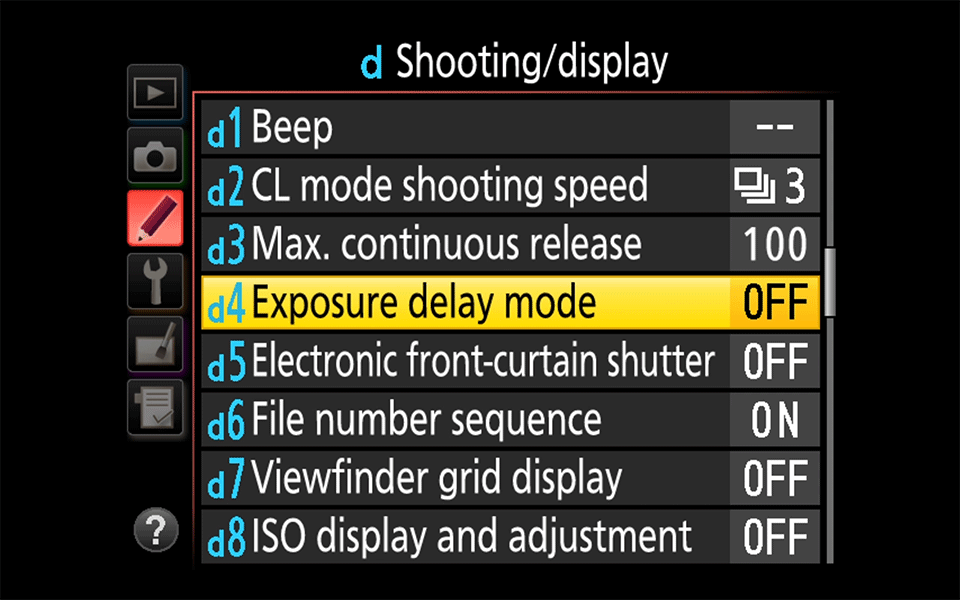
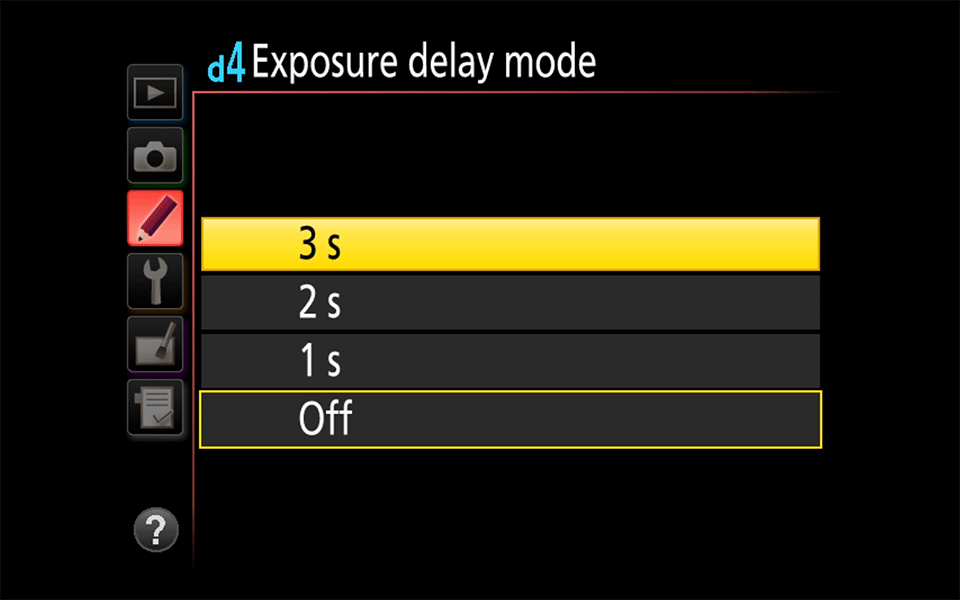
One time you get into the sub-menu, you will be presented with a choice of a timer ranging from 0.2 to 3 seconds (depending on camera model), every bit seen below:
iii) Programming Exposure Delay Way to a Button
Many photographers, including myself, prefer to program a button on our cameras to hands access EDM. For instance, on cameras such as the Nikon D7500, D500 and D810, it is possible to assign either the Function button or the Preview button to trigger EDM when used in combination with the rear button, as seen beneath:
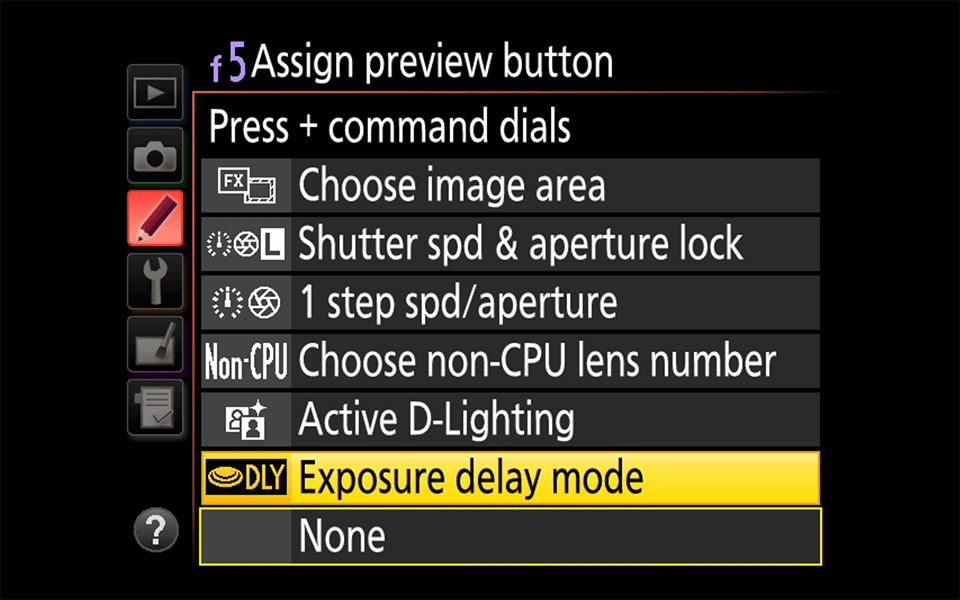
All you accept to do is visit Carte du jour -> Custom Setting Carte du jour -> Assign Fn Push / Assign Preview Button -> Press + Command Dials -> Exposure Delay Mode. In one case y'all assign EDM to a button, you have to press and concord the push, and so apply the rear dial to toggle betwixt different timers, or to plow the feature off.
Doing this will allow for quick changes to EDM in the field. Another mode to make it easier to access EDM is to add it to the camera's "My Carte" department, so assign a button to get to "My Menu" with a single printing of the button. Personally, I prefer the one-time method instead of going through the camera menu, because I tin keep my gloves on when working in cold environments.
four) Exposure Delay Mode vs Electronic Front-Curtain Shutter
It is of import to point out that EDM works very differently compared to Electronic Front-Curtain Shutter (EFCS). EDM is basically a timer that tin can be effective in reducing mirror slap vibrations, whereas EFCS is simply good for shutter shock vibrations. This means that ideally, you should be using the combination of the two in guild to reduce or even eliminate photographic camera shake from both the photographic camera mirror and the shutter on a DSLR camera.
five) Exposure Delay Mode vs Mirror Upward
While both EDM and Mirror Up can practice the aforementioned matter past raising the mirror and letting it stay in that position until vibrations are reduced or eliminated, the primary difference betwixt the two, is that one tin utilize EDM in combination with pretty much any camera mode, including Mirror Up. In essence, EDM is a timer before image capture. For example, when using Live View, EDM does non raise the mirror, since the mirror is already up – instead, it works as a timer before an image is captured.
If 1 uses Mirror Upward without EDM, the shutter release has to be engaged twice: the offset release raises the mirror and locks it in that position, whereas the second release captures the image and brings the mirror down. However, the main benefit of using EDM in combination with Mirror Up manner, is that it allows one to take pictures without needing a remote shutter release cable / trigger. When EDM is enabled and Mirror Up manner is selected, you tin employ your fingers to trigger the photographic camera shutter. When triggering the shutter release the commencement fourth dimension, the mirror is raised (if EFCS is enabled, the front mantle shutter is also raised at the aforementioned fourth dimension), then triggering the shutter release the second time will engage the EDM timer. The camera will await until the timer expires, then it volition capture the paradigm, after which the mirror comes downwardly. That filibuster between you squeezing the shutter release for the second time and the actual image capture is what allows vibrations to calm down, resulting in sharp images. Encounter beneath for more information about the different combinations of EDM and camera modes.
half-dozen) Exposure Delay Manner vs Remote Shutter Release
Since EDM is such a powerful feature to reduce camera shake, I pretty much stopped using a remote shutter release in the field. Now I only carry a remote shutter release for 1 reason – in gild to take exposures longer than thirty seconds. In fact, with such cameras as the Nikon D810 and D850, there is non fifty-fifty a demand for a remote shutter release for long exposures anymore. If I forget the remote shutter release cablevision or don't feel like plugging it in, I simply set the camera to "Fourth dimension" mode (Manual Mode, one click by "Bulb", appears equally two dashes "–"), and so burn down upward my phone'south timer to measure exposure length. Pressing the shutter release i more than time stops the exposure and I can practice this for any length of time, provided that my camera battery lasts.
Permit'due south take a look at different combinations of EDM and camera modes and see which ones work all-time in the field.
6.1) Exposure Delay Mode + Unmarried / Continuous / Quiet Release Modes
Even if you cull non to use the Mirror Upward mode, EDM can be very useful when shooting in other camera modes such as Unmarried, Continuous, Repose and Self-Timer. When shooting from a tripod, information technology is all-time to use EDM with at least 1 second timer in guild to dramatically reduce photographic camera milk shake. And so if you are in Unmarried, Continuous or Quiet modes, EDM with 1 2nd or longer will assist reduce mirror slap significantly. Notwithstanding, it is important to note that if your camera is equipped with EFCS, it is best to avoid using EDM + Single Release, EDM + Continuous Release modes or EDM + Quiet Release modes (D7500, D500, D810 and D5 only), considering EFCS does not piece of work in those modes.
Camera Beliefs: Mirror is raised as before long as the shutter release button is pressed (forepart drape shutter is closed, since EFCS is disengaged). Photographic camera waits until EDM timer expires, then captures the image. Mirror comes downward.
half-dozen.2) Exposure Filibuster Manner + Self-Timer
My personal favorite is EDM + Self-Timer mode on older Nikon DSLRs, because it reduces initial vibrations from my hand even before the mirror is raised. That's what I default to when shooting with the Nikon D800 / D800E. Notwithstanding, on newer cameras with EFCS (such as D7500, D500, D810, D850 and D5), information technology is best to avoid EDM + Self Timer, because EFCS is not engaged. On the Nikon D850, EDM + EFCS work in iii different photographic camera modes: Tranquillity (Q), Quiet Continuous (Qc) and Mirror Upward (Mup).
Photographic camera Behavior: Self-timer is engaged equally soon equally the shutter release push is pressed. After the timer expires, the mirror is raised (forepart curtain shutter is closed, since EFCS is disengaged). The camera waits until the EDM timer expires, and so captures the image. Mirror comes down.
6.3) Exposure Delay Way + Mirror Up + EFCS Off
Not an ideal combination when EFCS is available, because just vibrations from the mirror are reduced, while vibrations from the shutter machinery are however present.
Camera Behavior: Get-go shutter release raises the mirror immediately, but the front drape shutter remains closed, since EFCS is turned off. The camera stays put and waits for the 2d shutter release. Upon second shutter release, the photographic camera waits until the EDM timer expires, after which the image is captured and the mirror comes downwardly.
6.4) Exposure Delay Mode + Mirror Up + EFCS On
An ideal combination for all Nikon DSLRs that have EFCS. On newer Nikon DSLRs similar D850, it is also possible to apply EDM + Quiet / Tranquility Continuous Release Modes + EFCS On to completely eliminate camera milk shake from the photographic camera mirror, every bit well as the shutter mechanism.
Camera Behavior: Outset shutter release raises both the mirror and the front drape shutter, since EFCS is turned on. The camera stays put and waits for the second shutter release. Upon 2nd shutter release, the camera waits until the EDM timer expires, after which the prototype is captured and both rear drape shutter and the mirror come up downward.
Notation:
The behavior of EDM + Mirror Up on the Nikon D850 is different when using Live View. In Alive View mode, ane has to but press the shutter release once to take a picture, whereas older cameras like the Nikon D810 require engaging the shutter release twice.
6.five) Live View + Silent Shutter Mode + Self-Timer
The Silent Shutter Mode (too known as "Electronic Shutter") is only available on the Nikon D850. Ane must be in Alive View style and set upward the photographic camera by pressing the "i" button, navigating to "Silent alive view photography", then picking "Mode 1". Once turned on, the camera will not engage its shutter mechanism at all and there won't exist a need for either Mirror Upwardly or EFCS, since the mirror is already raised and the shutter mechanism is disabled. When using this feature, it is best to utilize information technology in combination with Self-Timer, just 1 tin can besides use information technology in combination with EDM timer.
7) Ideal Settings on Different Nikon DSLRs When Shooting From a Tripod
Based on the in a higher place, what are the ideal settings when shooting on different Nikon DSLRs? Allow's take a expect:
Older cameras with EDM and no EFCS (D7000-D7300, D600-D800/D800E, D3-D4S):
Exposure Delay Way (1-3 seconds) + Cocky-Timer, or Alive View + Exposure Delay Way (1-3 seconds).
Newer cameras with EDM and EFCS (D7500, D500, D810, D5):
Exposure Delay Mode (one-three seconds) + EFCS On + Mirror Upwardly, or Live View + EFCS On + Mirror Up.
Nikon D850:
Exposure Filibuster Manner (1-3 seconds) + EFCS On + Serenity / Quiet Continuous / Mirror Upwardly, or Live View + EFCS On + Mirror Up, or Alive View + Silent Shutter Mode + Self-Timer (when subject area is not moving).

Nikon D3200 How To Set Timer,
Source: https://photographylife.com/exposure-delay-mode
Posted by: triplettwitheir.blogspot.com
0 Response to "Nikon D3200 How To Set Timer"
Post a Comment